What Is CAN Bus? A Plain-English Guide for Installers
By Alec J. Reviewed byJames M.
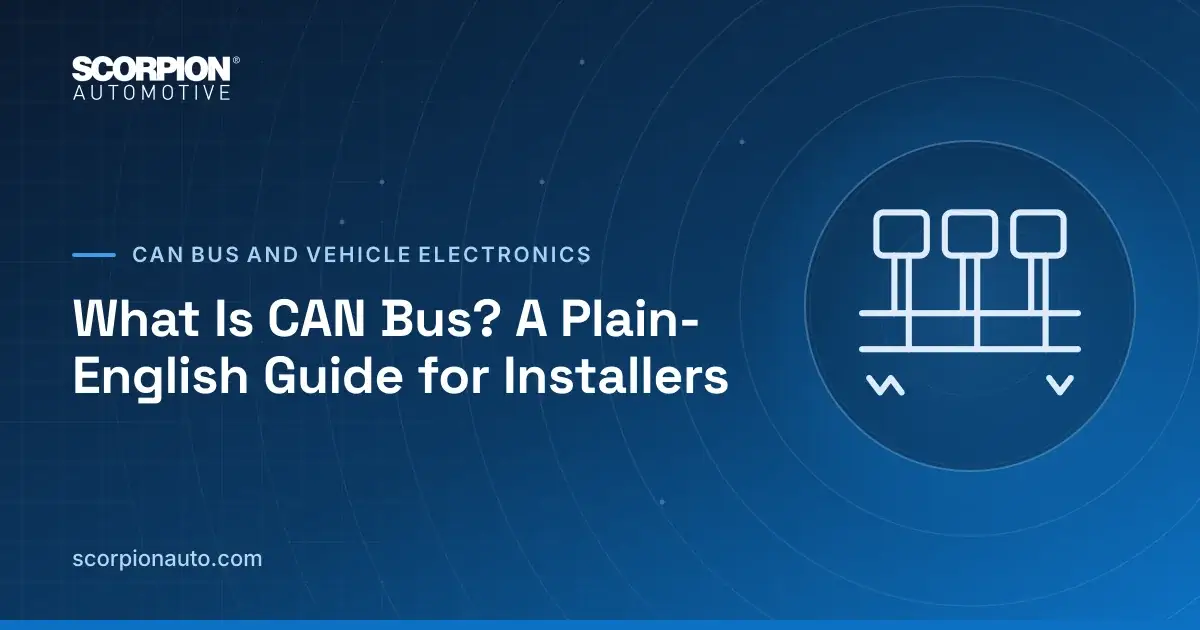
CAN bus (Controller Area Network) is the two-wire network that lets a vehicle’s electronic control units share information. Instead of running a separate wire for every signal, the engine, gearbox, body, dashboard and safety modules broadcast short messages onto one shared pair of wires, and each module reads the messages it needs.
Key facts:
- Developed by Bosch from 1983 and presented at the SAE congress in February 1986.
- First production car: Mercedes-Benz began using CAN in its upper-class cars in 1991.
- Standardised as ISO 11898 in November 1993, for bit rates up to 1 Mbit/s.
- Two wires: CAN High and CAN Low, usually twisted together.
- No addresses: every message is broadcast; each module decides what to listen to.
Why do vehicles use CAN bus?
Picture a car before networks. Every switch had its own wire to the thing it controlled, and every sensor had its own wire to every unit that needed its reading. As cars gained electronic engine management, ABS, airbags and comfort features, those looms grew heavy, expensive and hard to fault-find.
CAN solved that by letting units share one pair of wires. A wheel speed reading goes onto the bus once. The ABS, the speedometer, the gearbox and the cruise control all pick it up from there.
The idea came out of Robert Bosch GmbH, where development started in 1983. Bosch introduced the protocol at the Society of Automotive Engineers congress in February 1986, Intel shipped the first CAN controller chip in 1987, and Mercedes-Benz put CAN into production cars from 1991 (CAN in Automation). Today it’s in almost every car, van and truck on the road, along with buses, plant and agricultural machinery.
A short timeline of CAN
| Year | Milestone |
|---|---|
| 1983 | Bosch begins development |
| February 1986 | Protocol presented at the SAE congress |
| 1987 | Intel ships the first CAN controller chip |
| 1991 | Mercedes-Benz uses CAN in production cars |
| November 1993 | Standardised as ISO 11898, up to 1 Mbit/s |
| 2012 | CAN FD introduced by Bosch and General Motors |
Source: CAN in Automation, “History of CAN technology”, read 7 October 2026 (CiA).
How does CAN bus work?
Two wires, one difference
A CAN bus uses two wires called CAN High and CAN Low. Rather than reading the voltage on one wire, each module reads the difference between the two. Electrical noise from the ignition or alternator tends to affect both wires equally, so the difference stays readable. Twisting the pair together improves that further.
Each end of a high-speed CAN bus is terminated with a resistor, typically 120 ohms. Without termination, signals reflect back along the wires and corrupt the messages.
Messages, not addresses
A CAN message doesn’t say who it’s for. It carries an identifier that says what it is, such as engine speed or door status, plus a few bytes of data. Every module on the bus sees every message and simply ignores the ones it doesn’t need.
Priority by design
What happens when two modules talk at once? The identifier also sets priority. If two units start transmitting together, the one with the higher-priority identifier carries on and the other backs off and tries again. Safety-critical messages can therefore always get through.
More than one network
A modern vehicle rarely has a single bus. There’s often a fast network for the engine and chassis, a slower one for body functions like windows and lighting, and a gateway module passing selected messages between them. That’s one reason the same signal can be easy to reach on one model and hidden on another.
What does CAN bus mean for installers?
For anyone fitting aftermarket equipment, CAN changed the job.
On older vehicles you found the wire for reverse, ignition or road speed and tapped into it. On a CAN vehicle, many of those signals don’t exist as a dedicated wire. They exist only as messages on the network.
That has three practical consequences:
- Splicing can cause faults. Cutting into data wires, or loading a circuit the vehicle monitors, can trigger warning lights and fault codes.
- You need something that speaks CAN. A CAN interface reads the network and turns messages into simple outputs: a switched live, a reverse trigger, a speed pulse.
- Every vehicle is different. Message identifiers vary by manufacturer, model and year, so interfaces have to be built and tested for each platform.
That’s the job our CAN bus integration range does. An ignition and accessory output powers add-on electronics with the vehicle, while a multi-output interface gives speed, ignition, reverse, illumination and park brake from a single connection, with no cutting into the factory loom.
What does an interface turn CAN messages into? Scorpion’s interfaces each decode network messages for a given make and model into a plain output:
| Interface | Outputs it provides |
|---|---|
| Ignition and accessory output | Switched live that follows ignition, with a separate accessory-mode output where needed |
| Multi-output interface | Speed, ignition, reverse, illumination and park brake from one connection |
Source: Scorpion Automotive product pages, read 7 October 2026. Fitment is checked per vehicle, because message identifiers vary by manufacturer, model and year.
What does CAN bus mean for vehicle security?
The network that makes modern cars work also gives thieves a way in. Key programming through the diagnostic port and CAN injection both use the vehicle network to make the car accept a key that isn’t genuine.
The same network can work for the owner. A CAN bus immobiliser reads the car’s own buttons and holds the vehicle until the right sequence is entered. There’s no separate keypad to find and no cut wires to bypass. Scorpion’s X-Series works this way.
Classical CAN and what came next
The original specification, now called Classical CAN, runs at up to 1 Mbit/s with small data frames. As vehicles carried more data, Bosch and General Motors developed CAN FD (flexible data rate), introduced in 2012, which allows larger frames and a faster data phase (CAN in Automation). Vehicles also now use other networks alongside CAN for specific jobs, but CAN remains the backbone for most control and body signals.
Talk to us about CAN signals and interfaces
Need a signal off the network, or a CAN interface that isn’t on the shelf? Scorpion designs and manufactures CAN electronics in the UK.
- Speak to us about your vehicle and the signals you need
- CAN bus integration for the full range of interfaces
Frequently Asked Questions
What does CAN bus stand for?
CAN stands for Controller Area Network. It is a two-wire network that lets a vehicle’s electronic control units share messages, developed by Bosch in the 1980s and standardised as ISO 11898 in 1993.
What are CAN High and CAN Low?
They are the two wires of the bus. Modules read the voltage difference between them rather than either wire alone, which makes the signal resistant to electrical noise from the engine and charging system.
Can I tap into a CAN bus wire to get a signal?
It isn’t recommended. Many signals exist only as data messages, and splicing into network wires can cause faults. A CAN interface reads the messages and provides a clean output instead.
Why does a CAN bus need termination resistors?
Each end of a high-speed CAN bus has a resistor, typically 120 ohms, that stops signals reflecting back along the wires. Missing or damaged termination is a common cause of communication faults.
Do all vehicles use CAN bus?
Almost every modern car, van and truck uses CAN, often with several separate networks linked by a gateway. Very old vehicles and some basic equipment still use conventional wiring.
Speak to our team
Questions about vehicle security, tracking or fleet telematics? Our UK team will point you to the right product for your vehicle or fleet.
Related Products
View all products →

- CAN bus
- vehicle electronics
- installers
- fleet engineering

Alec J.
Software Engineer at Scorpion Automotive
Alec J., a Software Engineer at Scorpion Automotive in Chorley, covers CAN bus, vehicle electronics and electric vehicles.
Reviewed by James M., Technical Director at Scorpion Automotive


