How Does a Car Alarm Work? Sensors, Sirens and Immobilisers
By Mike B. Reviewed byJames M.
A car alarm works by watching the vehicle through a set of sensors and reacting when one of them is disturbed. Door, bonnet and boot switches cover the perimeter, ultrasonic sensors cover the cabin, and the control unit then sounds a battery-backed siren, flashes the indicators and, on most systems, keeps the engine from starting.
The short version:
- Control unit: the brain. It arms, disarms, reads every sensor and decides when to trigger.
- Perimeter protection: detects a door, bonnet or boot being opened.
- Interior protection: ultrasonic sensors notice movement or a sudden change of air inside the cabin.
- Siren: the noise, usually with its own back-up battery so cutting the car’s battery won’t silence it.
- Immobiliser circuits: stop the engine running while the system is armed.
What are the main parts of a car alarm?
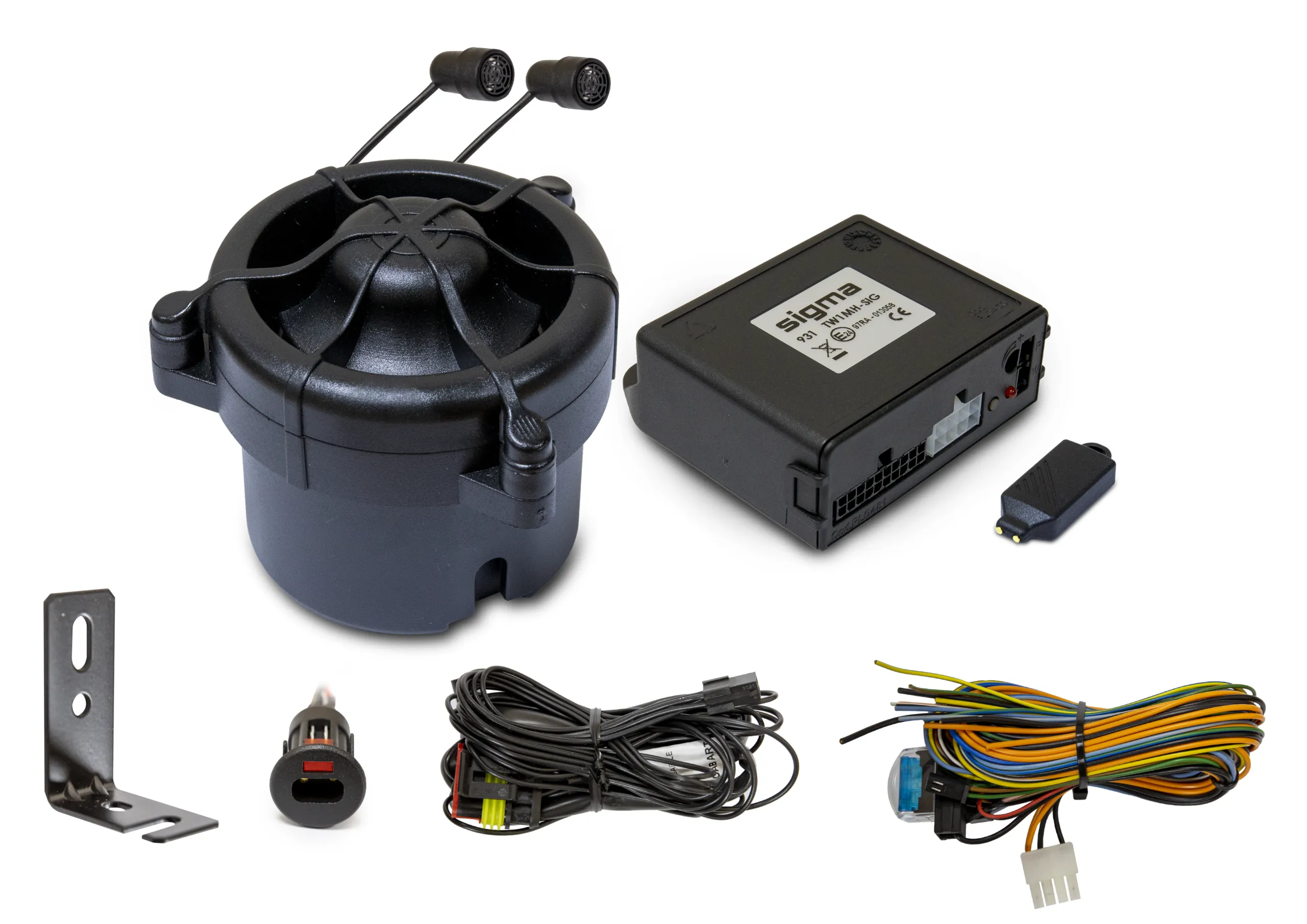
Every aftermarket alarm is built around the same handful of components. The kit in the photo above is typical: a control unit, a siren, a pair of ultrasonic transducers, an LED and the wiring looms that join them to the car.
The control unit is usually hidden behind trim or under the dash. It takes its power from the vehicle, listens to the sensors and holds the logic: how long the entry delay is, what counts as a trigger, how many times the siren sounds.
The siren is the part people notice. On better systems it contains a small rechargeable battery. If a thief cuts the main battery cable or pulls the siren’s supply, it keeps sounding on its own power.
The LED sits somewhere visible on the dashboard. Its slow flash tells a passer-by the car is protected, which is a deterrent in itself.
Then there are the sensors, which deserve their own section.
How does a car alarm detect a break-in?
Different sensors catch different kinds of attack. A complete system layers them so that whichever way a thief gets in, something notices.
Perimeter sensing
Perimeter protection covers anything that opens: doors, bonnet and tailgate. Older alarms read the courtesy light switches or added pin switches. Many current systems take door status straight from the car’s own network instead, so there are fewer wires to cut into. Either way, if a door opens while the system is armed, the alarm triggers.
Ultrasonic interior sensing
The two small round transducers are usually mounted high on the windscreen pillars. One sends out an ultrasonic tone the human ear can’t hear. The other listens to the echo that comes back from the cabin. When the cabin is still, the echo stays steady. A hand through a broken side window, or a person climbing in, changes the pattern and the control unit reacts.
That’s why ultrasonic alarms ask you to close the windows and sunroof before arming. Moving air through an open window can look like an intrusion.
Tilt and movement sensing
Some systems add a tilt sensor that notices the car being jacked up for its wheels or lifted onto a trailer. Convertibles and open vehicles often use microwave sensors instead of ultrasonic ones, because a fabric roof doesn’t hold the echo pattern the same way.
What happens when the alarm goes off?
Once a sensor trips, the control unit runs its alarm sequence. The siren sounds for a fixed cycle, the indicators flash and the immobiliser outputs stay locked. If the disturbance stops, the system resets and re-arms rather than sounding all night.
Some alarms also record which zone set them off. That helps when you need to know why the car went off at 3am: a door, the interior sensor or a power interruption each point to a different fix.
How is an alarm armed and disarmed?
There are two common approaches.
- The alarm’s own remote. The alarm comes with its own key fobs. You press a button to arm it, press again to disarm it. Scorpion’s S4 and S30 work this way.
- The car’s original remote (plip upgrade). The alarm reads the car’s factory locking, so locking the car with its normal key arms the alarm too. No extra fob on your keyring. The S12, S32, S34 and S37 use the original equipment remote.
Both routes usually include an override, such as a keypad code or a PIN entered through a switch, so you can still disarm the system if a remote fails.
Does a car alarm stop the car being driven away?
An alarm on its own makes noise. What stops the drive-away is the immobiliser, which interrupts circuits the engine needs to start or run.
In the UK’s Thatcham scheme, that distinction is built into the categories. Category 1 combines an alarm with an electronic immobiliser and includes sensors, a back-up power supply and a siren. Category 2 is an immobiliser on its own. A Category 2-1 alarm adds an alarm to a car that already has a Category 2 immobiliser, which lifts the car to Category 1 level (Motoring Research). Our guide to Thatcham categories explains each one in full.
Outside the UK, alarm systems and immobilisers fitted to vehicles in Europe are approved against UN Regulation No 116, the standard that sets out how these devices must behave (EUR-Lex).
How a Scorpion alarm puts it together
Scorpion has made vehicle alarms in the UK since 1973, for the aftermarket and for vehicle manufacturers. Every model in the S-Series alarm range uses perimeter and ultrasonic interior protection. They differ in how they’re armed and which Thatcham category they meet:
| Model | How it’s armed | Thatcham status |
|---|---|---|
| S4 | Own remotes, two supplied | Non-Thatcham |
| S12 | Original vehicle remote | Non-Thatcham |
| S30 | Own remotes, keypad programmer and override | Category 1 |
| S32 | Original vehicle remote | Category 2-1 |
| S34 | Additional radio keys, suits motorhomes | Category 2-1 |
| S37 | CAN bus upgrade, wireless PIR sensors for lockers | Category 2-1 |
If keyless theft is the bigger worry, an alarm is only half the answer. A CAN bus immobiliser such as the X-Series needs a PIN entered on the car’s own buttons before it will drive. The full line-up of alarms and immobilisers shows how the two fit together, and our vehicle security hardware page covers tracking as well.
Talk to us about choosing an alarm
Not sure which alarm suits your vehicle or what your insurer is asking for? Tell us the vehicle and the requirement.
- Speak to us about the right alarm for a car, van or motorhome
- S-Series alarms for the full range
Frequently Asked Questions
How does a car alarm know someone is inside?
Most alarms use ultrasonic sensors mounted near the windscreen. One sends out an inaudible tone and the other listens to the echo from the cabin. When someone reaches in or climbs inside, the echo changes and the control unit triggers the alarm.
Will a car alarm still sound if the battery is cut?
It will if the siren has a back-up battery. Battery-backed sirens keep sounding on their own power when the vehicle supply is cut, which is one of the requirements for a Thatcham Category 1 alarm.
Does a car alarm stop the engine starting?
The alarm itself makes the noise. Stopping the engine is the immobiliser’s job, and most aftermarket alarm systems include immobiliser circuits that stay locked while the system is armed.
Why does my alarm ask me to close the windows?
Ultrasonic sensors read air movement inside the cabin. Wind through an open window or sunroof can look like an intruder, so closing them before arming stops false alarms.
Can I keep using my car’s original key fob with an alarm?
Yes, with a plip upgrade alarm. It arms and disarms when you lock and open the car with the factory remote, so there’s no extra fob. Scorpion’s S12, S32, S34 and S37 work this way.
Speak to our team
Questions about vehicle security, tracking or fleet telematics? Our UK team will point you to the right product for your vehicle or fleet.
Related Products
View all products →

- car alarms
- S-Series
- vehicle security
- alarm sensors

Mike B.
Software Engineer at Scorpion Automotive
Mike B. is a Software Engineer at Scorpion Automotive in Chorley. Vehicle security, immobilisers and keyless theft are the areas Mike covers.
Reviewed by James M., Technical Director at Scorpion Automotive